
L. M. Montgomery · Classic family / coming of age · Updated 1 November 2026

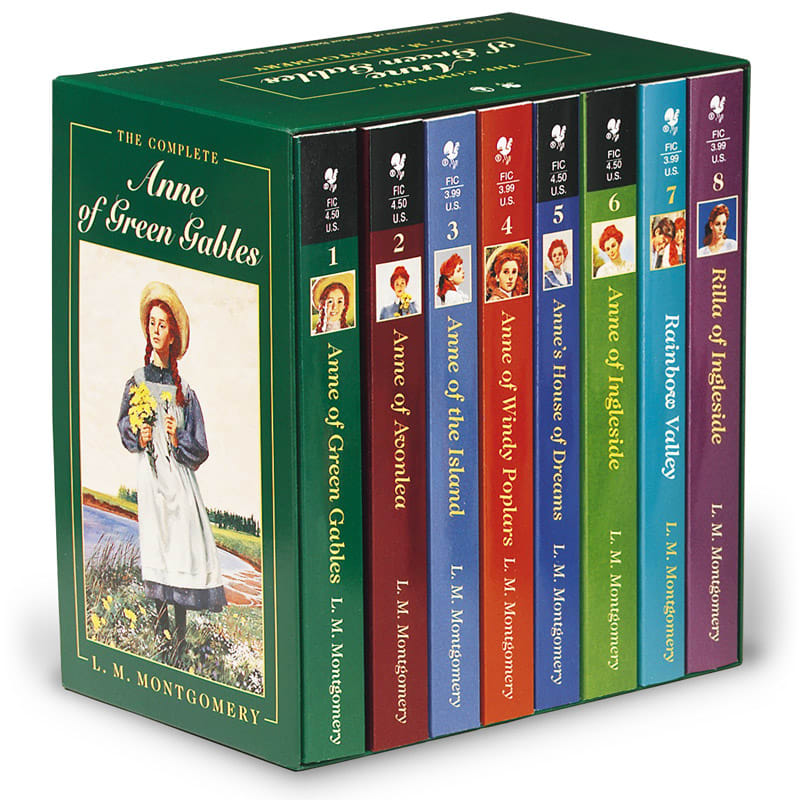
Linked edition: Eight-book box set · ISBN 9780553609417. Amazon US listing: 0553609416.
Affiliate disclosure: As an Amazon Associate I earn from qualifying purchases.
View Anne of Green Gables: Complete Eight-Book Box Set on Amazon US →
Our editorial assessment
The first Anne novel can be tried on its own before committing to the complete sequence. A box set makes sense when the reader already wants to stay with the characters across several stages of life. Check the included titles, print size and physical condition rather than assuming every Anne collection contains the same books.
Best suited to: Readers who already want the extended Anne series.
Consider another choice if: First-time readers who would prefer to sample one volume.
Source-based reading assessment; we do not claim a complete reading or physical inspection of the linked edition.
Reading guide and background
Anne of Green Gables, historical 1908 cover. Cover art by George Fort Gibbs; text by L. M. Montgomery. Wikimedia Commons public-domain record. Source web-size image; no edits by Enlighten Chakra.

Before you decide what you think of Anne, notice how the people around her form their first impressions. The opening of Anne of Green Gables gives three different characters a surprise. Reading those reactions side by side is a useful way into a novel that can otherwise seem familiar before you have opened it.
This guide stays with the first three chapters. It offers a small starting plan without summarising the later story or treating Anne as a character whose whole meaning is settled at the beginning.
Start with the chapter titles
L. M. Montgomery’s novel is available through Project Gutenberg, including an online text. Its opening chapter titles name Mrs Rachel Lynde, Matthew Cuthbert and Marilla Cuthbert in turn, each described as surprised. That repeated structure gives a first-time reader a clear question: what does each person expect, and what happens when the expectation fails?
If choosing a print copy, check whether it is complete, abridged or adapted. Sample the type and sentence style. The historical cover shown above belongs to a 1908 edition and is an archival image, not a current product recommendation.
Chapter one: watch an observer at work
Begin with “Mrs. Rachel Lynde Is Surprised”. Pay attention to how information moves through a community. What does Mrs Lynde see, what does she infer and what does she need to ask? Those are different kinds of knowledge.
Make two short notes: one detail directly supplied by the scene and one judgement made about it. Keep the notes separate. This helps you notice the distance between an event and the story someone immediately builds around it.
Chapter two: listen before you label
In “Matthew Cuthbert Is Surprised”, listen to Anne’s speech and Matthew’s responses. Notice how a conversation can reveal two people at once. Do you learn only from what is said, or also from what one person leaves unsaid?
Choose a short exchange and read it aloud without exaggerated voices. Then describe the difference between the speakers in one sentence. Try to use evidence about the conversation rather than labels such as “good”, “bad” or “annoying”.
Chapter three: compare the reaction
Read “Marilla Cuthbert Is Surprised” and return to your opening question. How is this surprise different from the previous one? What practical concern or assumption shapes the response? You do not need to decide who has the correct reaction before continuing.
| Chapter | Track this | Ask this |
|---|---|---|
| Mrs Rachel Lynde | Observation and inference | What is known, and what is being guessed? |
| Matthew Cuthbert | Speech and silence | How do the two speakers reveal each other? |
| Marilla Cuthbert | Expectations and decisions | What changes when a different person responds? |
The table is a reading aid, not an answer sheet. If a reader notices humour, landscape or a particular word instead, begin there and return to the text together. A useful conversation does not require everyone to notice the same thing.
Give the difficult parts room
The early story involves a child’s uncertainty about belonging and adults making decisions about her future. If reading with a younger person, preview the opening and leave room to pause. Avoid asking a reader to explain the scene through personal experiences they have not volunteered.
Older vocabulary may need a brief explanation. Read the whole sentence again afterwards so the unfamiliar word returns to its context. There is no need to interrupt every paragraph when the meaning is clear enough to follow.
Let a first impression remain changeable
After the third chapter, write: “My first impression of Anne is… because…”. Add one question you want the next chapters to answer. Keep that note and revisit it later; changing your mind can be evidence of attention, rather than a mistake.
For another opening that rewards looking beyond an immediate judgement, try our Secret Garden introduction. For an exercise in hearing different voices, see The Wind in the Willows read-aloud guide. Browse Books & Reading for more starting points.
Source note: authorship, chapter titles and the opening structure checked against Montgomery’s novel via Project Gutenberg on 31 October 2026. The notebook method and discussion questions are original editorial suggestions.
Check this edition on Amazon US → · More Classics →
Prices, availability and delivery can change. This U.S. link does not establish availability in India.
Leave a Reply