
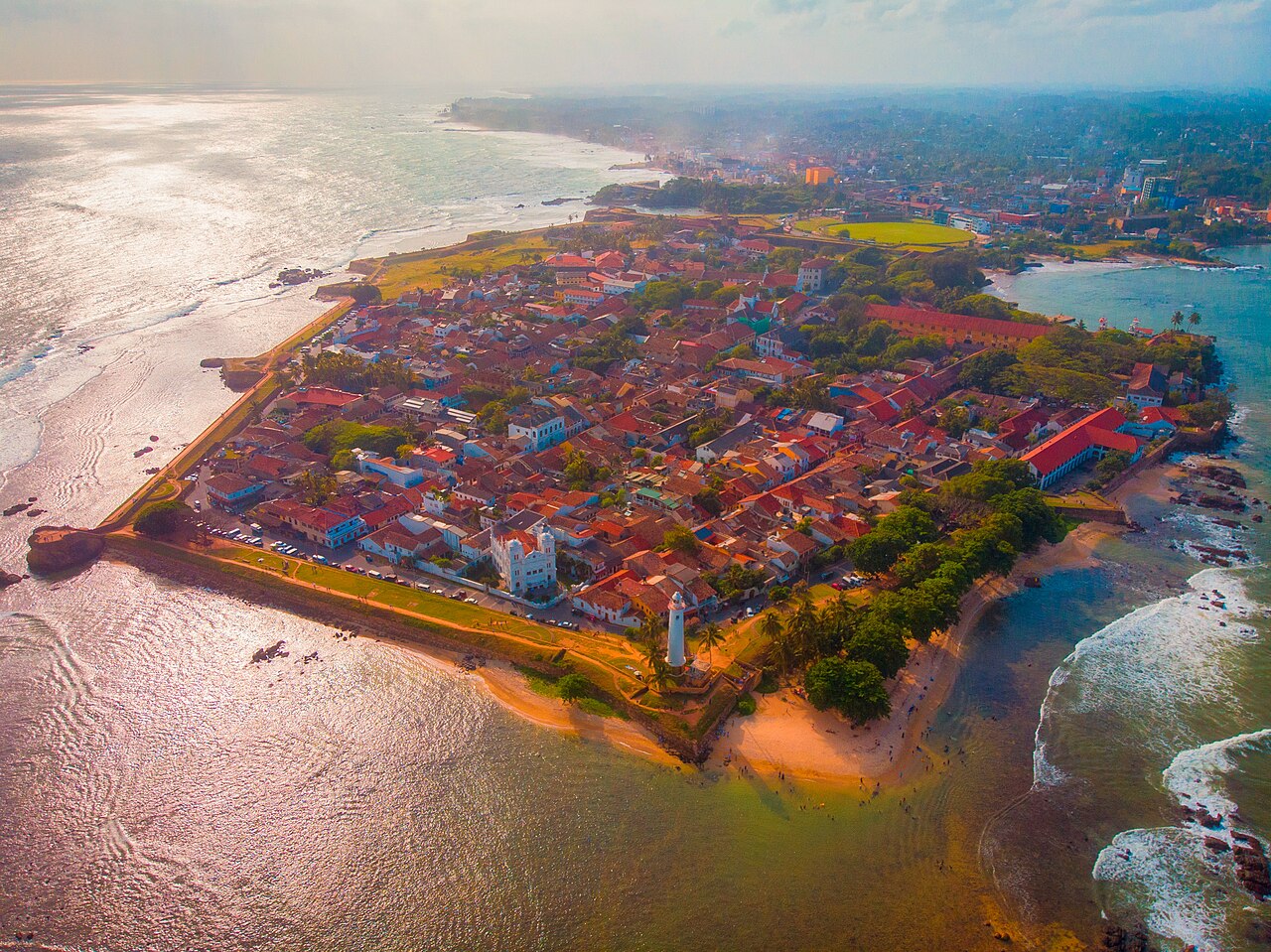
Galle Fort. Photograph: Rovin Shanila, 2018-07-21 16:21:20. Wikimedia Commons, CC BY-SA 4.0. Source web-size image; no crop, colour adjustment or retouching by Enlighten Chakra.

A photograph of Galle Fort can make the visit seem obvious: follow the sea wall and find a view. That is a good beginning, but it leaves out the part that makes the place worth a slower walk. The walls enclose streets, homes and everyday activity. Plan to look inward as well as out to sea.
The useful choice: give the visit three parts—orientation, a short street walk and a return to the edge. This is a suggested observation plan, rather than a timed tour or a report of a personal visit.
Start with the shape of the place
Galle’s old town occupies a rocky promontory on Sri Lanka’s southwest coast. UNESCO’s site description traces its development from Portuguese foundations in the sixteenth century to its Dutch period in the eighteenth. It highlights the meeting of European planning and South Asian building traditions. That combination gives you a useful question to carry: how do defensive walls and domestic streets work together here?
Before setting off, find an entrance and an exit on your map. Pick a small section of the perimeter that you can reasonably walk, then identify an inland street that returns towards your starting area. You do not need a complete circuit to understand the relationship between the sea and the town. Keep extra stops optional.
Three passes, with one task each
| Part of the walk | What to notice | What to record |
|---|---|---|
| At the edge | The coastline and the direction of the walls | A sketch showing sea, wall and town |
| Inside the streets | Street lines, shaded frontages and changes in building use | One detail you could explain without a photograph |
| Back towards the edge | How the town feels after you have seen its interior | One sentence comparing the two views |
On the first pass, resist trying to identify every structure. Look for the larger arrangement. Where does the wall turn? What does the land itself contribute to the outline? The aim is to make a rough mental map, not to produce an architectural survey.
On the second pass, put the camera away for one short stretch. Look at how doors, verandas and street-facing rooms meet public space. UNESCO describes a street grid and houses adapted through features such as verandas and courtyards. Observe from public areas; an open doorway is not permission to enter a private home.
Keep the visit small enough to enjoy
Choose one additional stop only after deciding how much walking you want. A museum, a shop or a long food break can each change the shape of the visit. Check that individual venue’s current opening details before making it essential. If you are with someone who needs step-free access, confirm the particular route rather than assuming the whole fortified area has the same surface or access.
Treat weather and comfort as part of the plan. Carry drinking water, allow a shaded break and shorten the exposed section if conditions make it uncomfortable. Stay on permitted paths, follow barriers and avoid moving towards an edge for a photograph. A shorter, attentive visit is a complete visit.
A note to take home
Write three lines before leaving: “The walls made me notice…”, “The streets changed that impression because…”, and “The detail I would show a friend is…”. Your answers will be more useful than another list of famous sights. They also make it easier to decide what you would explore on a return visit.
For a simple place to keep those observations, use our two-page city-break journal. For another approach to reading a historic town through its streets, see the Ahmedabad heritage-walk guide.
Map your rampart and street stops and leave room for a break with the trip planning worksheet. If you’re booking transport or a guided visit, use the travel booking checklist to compare inclusions and cancellation terms.
Source note: historical context was checked against UNESCO on 31 October 2026. The walking sequence and observation prompts are Enlighten Chakra’s editorial suggestions. Venue access, opening times and local restrictions should be checked for your visit.
Leave a Reply