
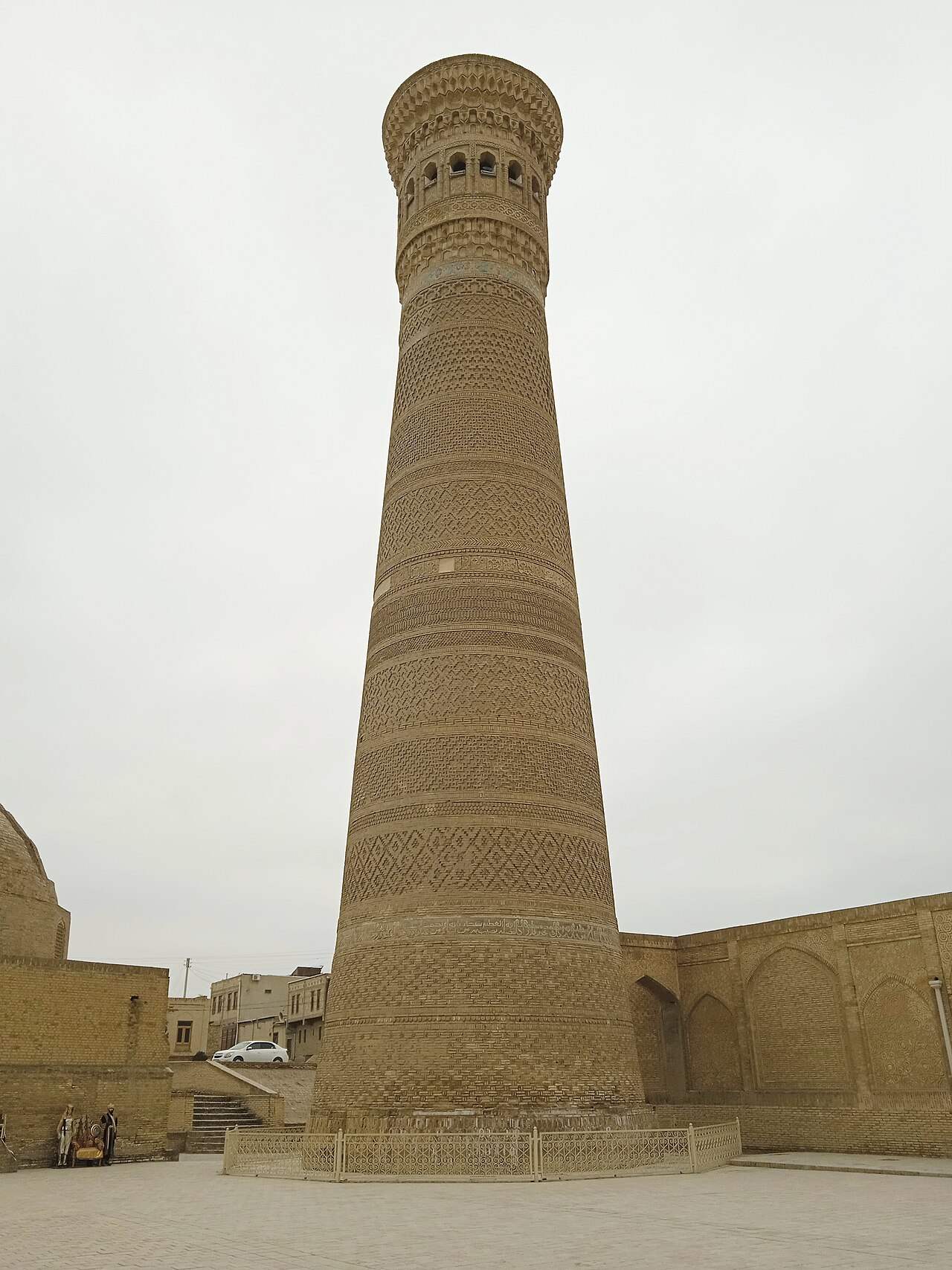
Kalyan Minaret, Bukhara. Photograph: St. Christofor, 2023-02-25. Wikimedia Commons, CC BY-SA 4.0. Source web-size image; no crop, colour adjustment or retouching by Enlighten Chakra.

Bukhara’s monuments can fill a long itinerary before you have decided what you want to see. For a first visit, choose a simpler subject: how a large landmark and its smaller details work together. Begin with the Kalyan Minaret as an orientation point, then give the brickwork some attention of its own.
Why the setting matters
UNESCO’s Historic Centre of Bukhara description connects the city with the Silk Route and recognises the survival of its medieval urban fabric. Its account highlights monuments including the tomb of Ismail Samani and numerous madrasas. The value of the visit lies partly in seeing a historic city together, rather than treating every monument as an unrelated stop.
That does not mean attempting the whole centre in one walk. Find the Kalyan area on a current map, mark where you will arrive and return, and identify one additional place you may want to visit. Use actual distances and your available time to decide whether the second stop belongs on the same outing.
First look: a landmark in public space
From a permitted public viewpoint, take in the minaret’s overall outline. Notice how its height changes your sense of the surrounding buildings. Move only within areas where visitors are allowed, and avoid standing where you block an entrance or a route used by others.
Before taking several photographs, decide what the first image needs to show. An overall view should explain the setting. A close view should explain a particular feature. Giving the two pictures different purposes makes the visit more interesting than collecting near-identical frames.
Second look: the surface has structure
Look for a band or repeated pattern that you can see clearly from ground level. Trace how the repetition works: where does it begin, where does it change and how does it sit against the larger form? You are looking at an arrangement, not just choosing something decorative.
Try writing a description without the words “beautiful” or “intricate”. For example, describe whether a pattern repeats horizontally, whether shadows make it easier to see, or whether a change in scale draws your eye. Use only what is visible. A photograph does not establish the age of each surface or the extent of restoration.
| Scale | A question to carry | A useful record |
|---|---|---|
| The setting | How does the minaret organise the view? | One overall photograph or sketch |
| The surface | How does one repeated pattern work? | A short description of its arrangement |
| The city | What do I want to understand next? | One chosen follow-up stop |
Choose a second subject rather than a second checklist
If the first stop makes you curious about religious and educational buildings, research a specific mosque or madrasa and confirm its visitor arrangements. If brick construction interests you most, look into the Ismail Samani monument as a separate, deliberate choice. Check the route and access before deciding how the stops fit together.
A named building is not a promise of unrestricted entry. Follow the current rules for religious spaces and ask about photography where necessary. A public exterior view and permission to enter a courtyard or interior are different matters.
A practical plan for the day
Keep a break and a clear return plan. Check weather and current local visitor information before setting out. If heat, stairs or uneven surfaces affect your visit, ask about the particular places and paths you intend to use, then shorten the plan when needed.
Finish with one sentence explaining what changed when you looked closely. Perhaps the landmark first seemed like a single shape, then became a series of deliberate patterns. That is a concrete memory you can carry into the next architectural visit.
For a different way to connect a landmark with its wider settlement, read our Bahla Fort and oasis guide. Keep the wide view and the detail together in the two-page travel journal.
Planning a Bukhara visit? Use the free trip-planning worksheet to organise walking time, transport, accommodation and your daily budget. Before reserving a stay or guided tour, review the travel booking checklist for inclusions, cancellation terms and total costs. Confirm current entry rules and opening arrangements with official sources.
Source note: historical context checked against UNESCO on 31 October 2026. Observation exercises and the suggested sequence are editorial guidance. Current entry rules, prices, hours and conditions must be checked for your visit.
Leave a Reply