
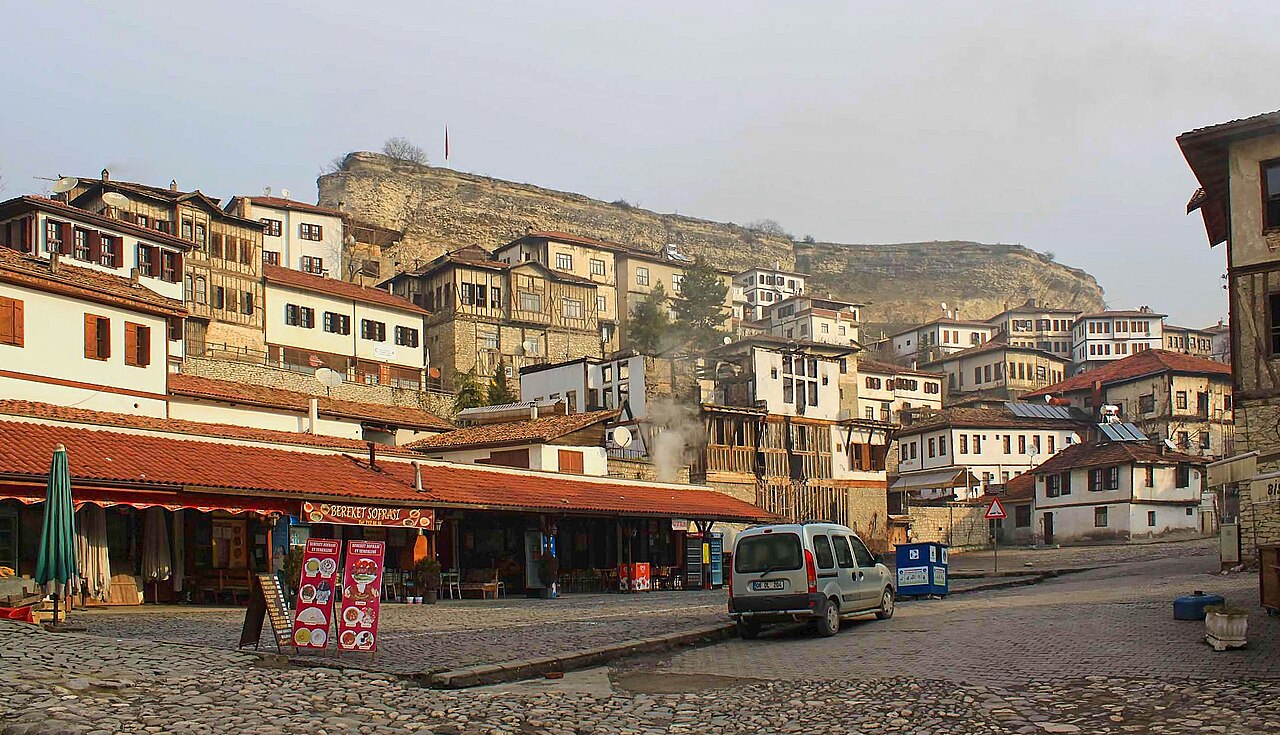
Buildings in Safranbolu. Photograph: Vyacheslav Bukharov, 2011-02-24. Wikimedia Commons, CC BY-SA 4.0. The source file includes the photographer’s perspective correction. Source web-size image; no crop, colour adjustment or retouching by Enlighten Chakra.

A photograph of Safranbolu’s houses can make the town look like one continuous neighbourhood. Before planning a walk, look at the districts. Choosing one area with a clear purpose gives you a better first visit than trying to connect every attractive building on a map.
Three district names worth recognising
UNESCO identifies three historic districts in Safranbolu: Çukur, the inner-city market area; Kıranköy; and Bağlar, the Vineyards. Its historical account describes a caravan station that prospered on an East–West trade route, with architecture that became influential during the Ottoman period. The town’s heritage is broader than a single house type.
Start by locating the area where you will arrive or stay. Then mark the historic area you most want to explore. Do not assume that all three district names describe stops on one short pedestrian circuit. Check the actual route and transport before choosing more than one.
Make the first walk about how houses meet the street
Pick a small public route and look at the relationship between buildings, street width and changes in level. Notice how an upper floor relates to the space below and how entrances create a boundary between public and private life. Describe the relationship before trying to attach an architectural term.
Keep one comparison in mind: does the view of a whole street tell you something a tightly framed house photograph would hide? The surrounding buildings and the route between them can explain the townscape more clearly than an isolated façade.
Photograph from public places and respect residents’ privacy. A restored appearance does not identify a building as a museum. An open door, terrace or garden is not an invitation to enter.
If you want to go inside a historic house
Find a named property that explicitly offers visitor access. Check its own opening information, admission details and photography rules. Ask whether rooms, stairs and surfaces suit your needs. A historic-house visit can involve different access from the street outside.
Inside, choose one question rather than trying to remember every object: how is movement organised between rooms, how is light admitted, or where does the interior connect with the outside? Use the property’s interpretation to understand particular functions. Avoid inventing a use for a room because it resembles something in another house.
| Before choosing | Find out | Why it matters |
|---|---|---|
| A district | Where it sits relative to your arrival point | Prevents an overextended route |
| An interior visit | Whether that exact property welcomes visitors | Separates a home from an attraction |
| A longer walk | Steps, surfaces, gradients and return options | Makes the plan fit the people travelling |
Let trade explain more than a souvenir stop
The caravan history offers a useful question for the market area: what kinds of spaces help a trading town function? Look for relationships you can actually observe, such as how shops address routes and gathering places. Use reliable interpretation for the historical role of a specific building.
A present-day business is also somebody’s workplace. Ask before close photography or demonstrations, and distinguish browsing from permission to handle objects. You can learn something from a short conversation without expecting a performance for visitors.
Keep one complete, manageable version of the day
Define a small visit you would enjoy even if you did nothing extra: one district, one thoughtful walk and a break. Add a confirmed interior visit if it interests you. A second district can remain a separate outing rather than becoming a deadline.
Check the forecast, current local access information and your return journey. If you are staying in a historic property, ask about the route from the drop-off point as well as room access; the final stretch can matter as much as the accommodation itself.
For another way to read a historic town through its streets, try the Tallinn Lower Town and Toompea guide. For a choice between two trading-city experiences, see Melaka or George Town.
Make your Safranbolu walking plan practical: Use the free trip-planning worksheet to organise your route, travel dates, transport and budget. Before reserving accommodation or guided activities, review the travel booking checklist for total costs, inclusions and cancellation conditions. Confirm current access details with official providers.
Source note: district names and historical context checked against UNESCO on 31 October 2026. The planning approach is an editorial suggestion, not a personally tested route. No current opening hours, entry prices or transport times are assumed.
Leave a Reply