
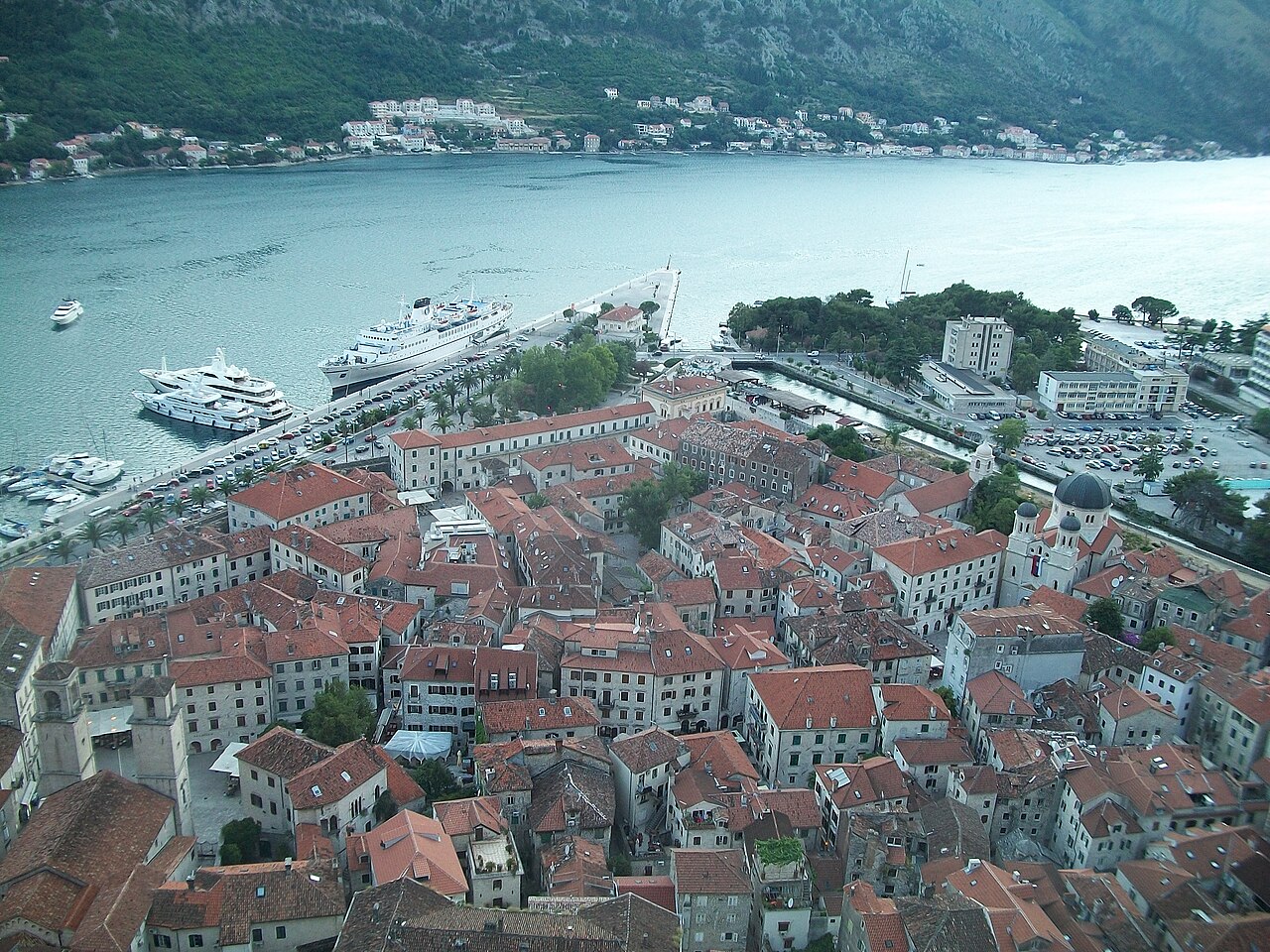
Kotor Old Town viewed from above; wider setting shown for context. Photograph: Adis1618, 2011-06-28. Wikimedia Commons, CC BY-SA 4.0. Source web-size image; no crop, colour adjustment or retouching by Enlighten Chakra.

The hillside view of Kotor can make the fortress climb seem like the reason to visit. You can build a satisfying first visit around the Old Town itself. Give the streets, squares and harbour setting enough attention, and leave the climb as a separate choice.
This is a no-climb planning approach, not a step-free route certification. Individual buildings, paths and entrances still need checking if steps or uneven surfaces are a concern.
Put the town back into its setting
UNESCO’s description of Kotor’s region places it on Montenegro’s Adriatic coast and explains its medieval importance as an artistic and commercial centre. It also records the serious damage caused by the 1979 earthquake and subsequent restoration. The heritage story includes the town’s relationship with the wider landscape, rather than just a single high viewpoint.
Begin with a current map. Mark your arrival point, an Old Town entrance and a place where you can comfortably finish. If you have a fixed departure, work backwards from it and include the journey back. Keep a clear margin instead of planning to use every available minute.
Make your first walk about connections
Choose a small route between two public spaces inside the Old Town. As you move, notice how a narrow passage opens into a square and how buildings address that space. Use the map when you need it; getting lost is not a requirement for an interesting visit.
At one stop, look for a doorway, window or piece of stonework that catches your attention. Write down what you can see before guessing what it means. A guide or reliable interpretation can help distinguish a historic feature from later repair; appearance alone is not a dependable date.
Choose one interior, rather than every doorway
If you want a museum or church visit, pick one based on your interests and verify its current visitor information. Check opening arrangements, admission and photography rules with the operator. Religious spaces may have uses that take priority over sightseeing.
Leave the rest of the walk flexible. A quiet pause in a public space can add more to the visit than another interior entered without time to understand it. Avoid assuming that an open passage or residential stair is a visitor route.
| Part of your visit | What it adds | Decision to make |
|---|---|---|
| Old Town walk | Street layout and architectural detail | How much walking is comfortable? |
| One interior stop | A closer look at a chosen subject | Is it open, and does access suit you? |
| A permitted outside view | The town’s relationship with its setting | Can you reach it comfortably within your time? |
Let the bay be context, not another booking
Find a permitted public place where you can understand the relationship between the town and the water. You do not need to add a boat trip to make that connection. If you do want one, investigate it as a separate activity with its own operator, duration, conditions and return arrangements.
The same applies to a fortress ascent. Do not start simply because you have finished lunch and it looks close on a photograph. Check the actual route, current access and conditions, then decide whether that is the experience you want. Saving it for another visit is a complete decision.
What a short visit can reasonably deliver
Aim to leave with three things: an understanding of the Old Town’s layout, one detail you can explain and a sense of its setting. Those are meaningful outcomes even if you have not climbed above the roofs.
Check weather and local access information before the day, keep to permitted routes and allow a break. If accessibility is important, ask about specific paths and entrances rather than relying on the broad label “Old Town”.
For a different coastal fortified-town approach, read the Galle Fort first-visit guide. Use our two-page journal to record the detail you would return to see again.
Plan your Kotor visit. Use the trip planning worksheet to map your Old Town walk and set a budget. If you’re booking a transfer or guided walk, use the travel booking checklist to compare meeting points, inclusions and cancellation terms.
Source note: historical context checked against UNESCO on 31 October 2026. This editorial plan does not claim personal route testing or confirm current attraction access, prices or opening times.
Leave a Reply