
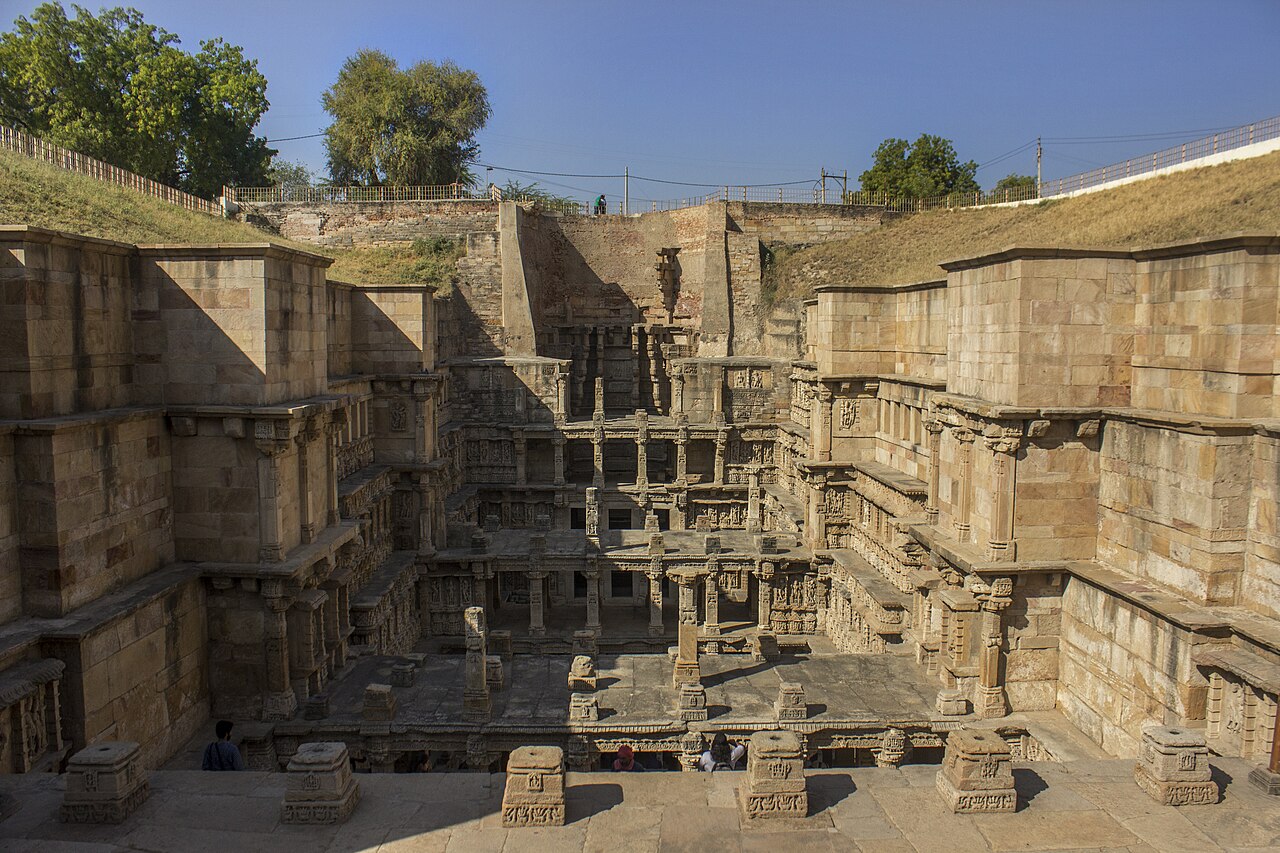
Rani-ki-Vav, Patan. Photograph: Taru23, 2016-11-01. Wikimedia Commons, CC BY-SA 4.0. Source web-size image; no crop, colour adjustment or retouching by Enlighten Chakra.

Two stepwells on a Gujarat wish list do not automatically make one sensible outing. Start with the place you are staying and the detail you most want to understand. Rani-ki-Vav in Patan and Adalaj near Ahmedabad offer different ways to look at architecture built around water.
Quick choice: make Rani-ki-Vav the focus if a dedicated Patan visit and sculptural detail are your priorities. Consider Adalaj if you are planning around Ahmedabad or Gandhinagar and want to study a layered, columned interior. Check your actual transport options before deciding that either fits a spare afternoon.
What is different about the two?
UNESCO describes Rani-ki-Vav as an eleventh-century memorial, designed around the idea of an inverted temple and divided into seven levels. Its sculptural panels include religious, mythological and secular subjects. Gujarat Tourism describes Adalaj as a five-storey stepwell with carved pillars, three entrances and an octagonal opening. These are historical design descriptions; they do not promise that every level is open to visitors today.
| Your priority | Rani-ki-Vav, Patan | Adalaj |
|---|---|---|
| Reading the overall form | Follow the relationship between descent, terraces and sculptural panels | Follow the relationship between openings, columns and stacked spaces |
| Looking closely | Choose one panel and study its composition | Choose one carved element and compare it with the surrounding structure |
| Building an itinerary | Start with a Patan-focused plan | Start with an Ahmedabad or Gandhinagar-based plan |
| Before committing | Check current entry, permitted access and transport | Check current entry, permitted access and transport |
At Rani-ki-Vav: move from the whole to one detail
Begin at a permitted viewpoint where you can understand the length and depth of the structure. Notice the rhythm of the repeated architectural elements before trying to name individual figures. Then choose one panel that you can comfortably see. Ask how its figures fit the stone frame and how the surrounding architecture directs your eye.
Give yourself a concrete task: make one wide photograph for the setting, one closer view for a detail and one written sentence connecting them. If access or distance prevents a close photograph, use a note instead. A zoomed image is not a reason to cross a barrier.
Our Patan and Rani-ki-Vav first-visit guide develops the single-destination approach. Use that when Patan is already part of your trip, rather than trying to compress both stepwells into a checklist.
At Adalaj: follow the frame around the view
At a permitted stopping point, look at a view through two or more columns. Notice what becomes visible through the next opening, and what the stone frame conceals. Then turn your attention to a smaller carved motif. This change of scale can make the visit more rewarding than taking several versions of the same downward photograph.


Try describing the space without using “beautiful” or “intricate”. Words such as repeated, shaded, framed, narrow or layered force you to be specific. If you are visiting with a child or a friend, choose different details and compare what caught each person’s attention.
Should you visit both?
Choose both when each has a distinct purpose in your plan and your transport arrangements leave room to look properly. Choose one when the second would mean hurried travel, missed meals or pressure to reach a closing gate. Neither choice needs a ranking of which monument is “better”. The useful comparison is between the visit you want and the day you can actually make.
Before setting out, confirm current opening arrangements, ticket requirements, permitted areas and the return journey. Historical depth is not a measure of visitor accessibility. If stairs are a concern, ask specifically what can be seen without descending. Keep to designated routes and leave space for other visitors on narrow sections.
Pair an Adalaj-focused plan with our Ahmedabad heritage walk; keep the city walk and the stepwell as separate decisions until you have checked the logistics.
Source note: architectural context was checked against UNESCO and Gujarat Tourism on 31 October 2026. The comparison and observation exercises are editorial recommendations; no current journey times, ticket prices or opening hours are assumed.
Leave a Reply