
Lewis Carroll · Nonsense fantasy · Updated 1 November 2026

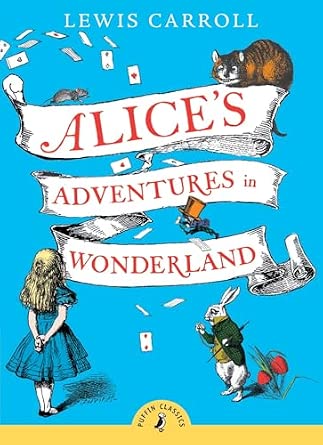
Linked edition: Puffin Classics paperback · ISBN 9780141321073. Amazon US listing: 0141321075.
Affiliate disclosure: As an Amazon Associate I earn from qualifying purchases.
View Alice’s Adventures in Wonderland on Amazon US →
Our editorial assessment
The pleasure often comes from treating an impossible exchange with complete seriousness. Read for the shifts in rules and language rather than trying to turn every episode into a single lesson. For a young reader, unfamiliar wordplay can work well aloud, with permission to pause and reread.
Best suited to: Readers who enjoy verbal play and unstable rules.
Consider another choice if: Readers who need a realistic world with consistent explanations.
Source-based reading assessment; we do not claim a complete reading or physical inspection of the linked edition.
Reading guide and background
White Rabbit illustration by John Tenniel (1865). Wikimedia Commons public-domain record. No edits by Enlighten Chakra.

Alice’s Adventures in Wonderland can be harder to begin than its familiar characters suggest. You may recognise the White Rabbit but find the actual sentences stranger than expected. That is a useful place to start. Read the opening as a sequence of changing rules, and let a few questions remain unanswered.
This plan covers the first three chapters. Use one chapter per session, or pause more often if you are reading aloud together. There is no target reading speed. The purpose is to find a way into Lewis Carroll’s text before deciding whether to continue.
Choose the text before choosing the pace
Use a complete edition of Alice’s Adventures in Wonderland if you want to follow this chapter plan. A retelling may rearrange or shorten the scenes. Project Gutenberg lists free reading formats, including an online text. Its site explains the conditions for use in different countries. Check the sample pages of a printed edition for legible type and illustrations that you enjoy.
If you are reading with a child, preview a few pages first. Long sentences, unfamiliar words and sudden uncertainty may need a pause or an explanation. Instead of choosing solely by an age label, listen to how the particular reader responds. It is fine to stop at the end of one scene.
Session one: follow the question
Begin with Chapter I, “Down the Rabbit-Hole”. Notice the moment when something unusual becomes interesting enough for Alice to follow. You do not need to predict where it leads. Keep a small note with two columns: what Alice expects, and what actually happens.
The most useful discussion question is simple: which detail first made the ordinary world feel different? Let each reader choose a different answer. If a sentence feels tangled, try reading it aloud once before explaining it. Its rhythm may carry part of the joke.
Session two: notice how certainty slips
Read Chapter II, “The Pool of Tears”. Carry forward the expectation note, but add a new question: what does Alice do when familiar ways of understanding herself and her surroundings stop helping? Avoid turning every oddity into a symbol with one correct explanation.
Pause after a moment that seems confusing or funny. Can you point to the exact word or assumption that produces the effect? One good example is enough. You are practising attention to the writing, rather than trying to master the whole book at once.
Session three: listen for the disagreement
Read Chapter III, “A Caucus-Race and a Long Tale”. Pay attention to what happens when a group tries to organise itself and when words are understood in different ways. If reading aloud, let two readers take different voices. Keep the performance light; no elaborate accents are needed.
| After the chapter | Write one line | Talk about one question |
|---|---|---|
| I | Something ordinary became strange when… | What made you want to follow Alice? |
| II | A familiar rule stopped working when… | How did Alice respond to uncertainty? |
| III | The conversation went sideways when… | Did everyone mean the same thing? |
These prompts are starting points, not answer sheets. A reader who remembers the sound of a line rather than the plot can begin there. Return to the passage together and see what the words support.
Decide how to continue
After three sessions, ask what you want more of: the conversations, the visual scenes, the wordplay or the movement from one surprise to another. That answer can guide your next session. If the book has not caught your attention, leave a bookmark and try something different; finishing a famous title is not the only useful outcome.
For a different kind of close attention, try our three-story Sherlock Holmes starting plan. If you want a small shared reading routine, the Pride and Prejudice five-chapter guide offers another model. Browse the Books page for more reading guides.
Text and scope: chapter titles and the opening sequence were checked against Carroll’s original novel via Project Gutenberg on 31 October 2026. The session structure and discussion prompts are original editorial suggestions. This guide concerns Alice’s Adventures in Wonderland, rather than its separate sequel, Through the Looking-Glass.
Check this edition on Amazon US → · More Classics →
Prices, availability and delivery can change. This U.S. link does not establish availability in India.
Leave a Reply