
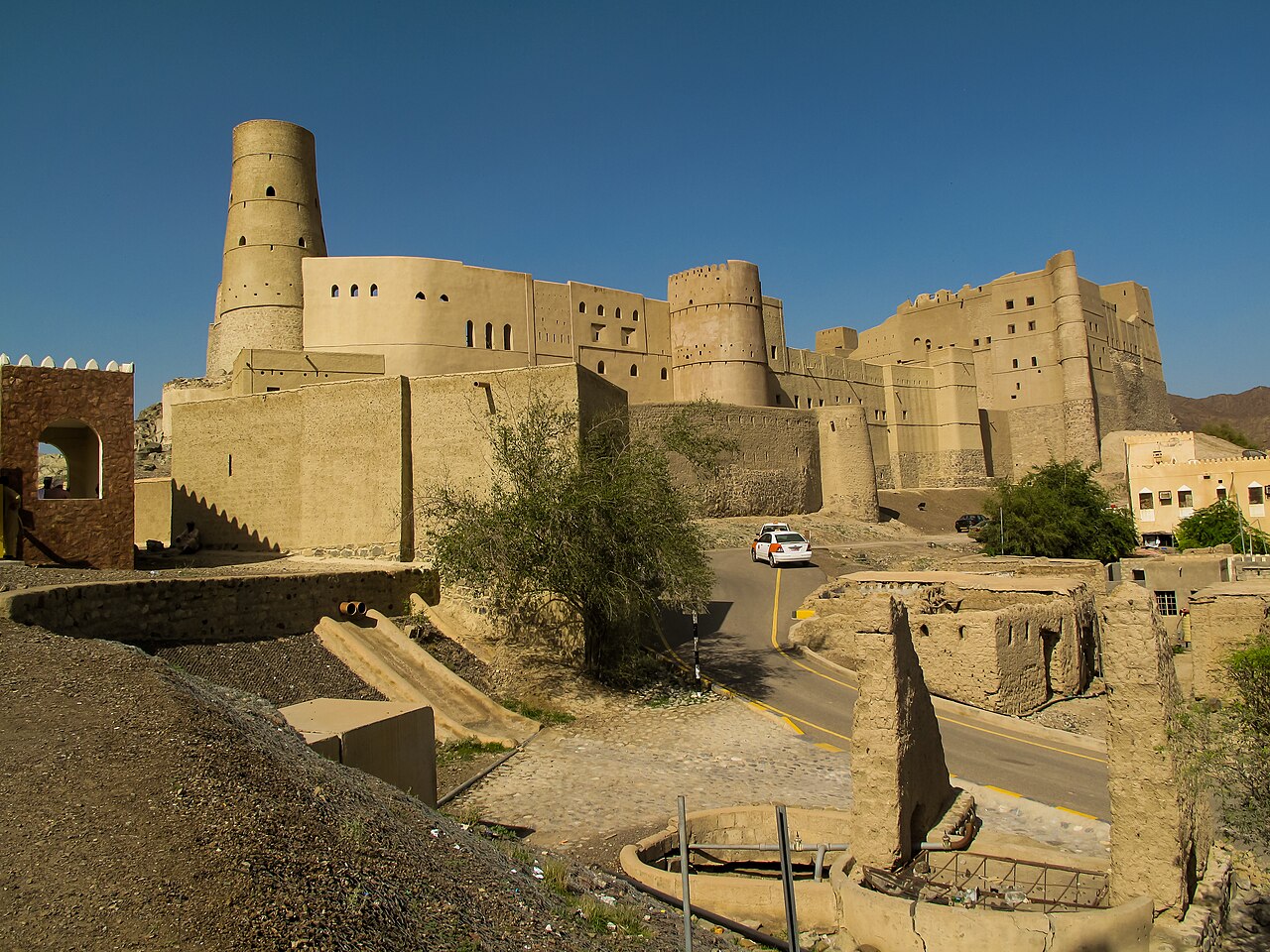
Bahla Fort, Oman. Photograph: Francisco Anzola, 2013-05-11 08:12:33. Wikimedia Commons, CC BY 2.0. Source web-size image; no crop, colour adjustment or retouching by Enlighten Chakra.

A fort can be easy to reduce to a climb and a view. At Bahla, a more rewarding starting question is what the fort helped to protect. Looking at the surrounding settlement and the role of water gives the walls a purpose before you begin studying their shape.
Best use of this guide: plan one focused heritage stop around three relationships—fort and settlement, settlement and water, and building material and maintenance. The suggested observation sequence does not assume that every part of the site is open.
The fort belongs to a larger story
UNESCO’s Bahla description places the fort within a fortified oasis settlement. It identifies mud-brick construction on stone foundations and connects the settlement’s prosperity with the Banu Nebhan, who made Bahla their capital between the twelfth and late fifteenth centuries. Its account also explains the role of the falaj water system in supporting the oasis.
You do not need to memorise a dynasty to make use of that context. Carry two questions instead: where is the fort in relation to everyday settlement, and how could a place here support people beyond its walls? The answers turn a defensive building into part of a working landscape.
First look: position before detail
At a permitted exterior viewpoint, give yourself time to understand the outline. Look for changes in height, the relationship between walls and towers, and how the building occupies its setting. Use the photograph above as historical visual context, not as a guarantee that your visit will have the same view or access.
Make a rough sketch using three labels: fort, settlement and cultivated area. Record only what you can actually identify. Leave a question mark where you are unsure. That is a better record than drawing connections because they sound plausible.
Second look: how the building is made
Where current visitor access allows, look at a wall surface, an opening and a junction between elements. Ask what you can see directly and what would require a guide or interpretation panel to explain. Colour and surface texture alone are not enough to date a section or decide which work is original.
UNESCO discusses both earthen construction and conservation. Keep those ideas together: the appearance of a historic building also reflects the work needed to keep it standing. Avoid presenting every smooth surface as ancient or every irregular one as evidence of neglect.
| Question | Look for | Avoid assuming |
|---|---|---|
| What did the fort oversee? | Its relationship to the surrounding landscape | That every nearby building is part of the visitor route |
| How was the oasis supported? | Reliable interpretation about water and settlement | That a visible channel is open for visitor exploration |
| How is the building maintained? | Site interpretation and clearly identified materials | A construction date based only on appearance |
Plan the practical parts separately
Confirm current admission, opening arrangements and any restricted areas through the site operator or an official local visitor source before setting out. Check the actual outward and return journey. A travel article should help you choose the experience; it cannot reserve transport or promise that a particular room will be accessible.
If stairs, heat or uneven surfaces are a concern, ask which parts can be visited comfortably before buying into a longer plan. Carry water, use permitted routes and stay back from edges. Treat homes, gardens and cultivated land outside the visitor area as private unless access is clearly offered.
Take away one connected explanation
Before leaving, complete this sentence: “The fort makes more sense when I connect it with…”. Try to include something beyond the towers. If your answer is water, explain what you learned from a reliable source and what you simply observed. Keeping those separate makes your travel notes more accurate.
For another way to read architecture through water, compare Rani-ki-Vav and Adalaj in Gujarat. They serve a different architectural story, but the exercise of connecting structure and purpose travels well.
Source note: historical and architectural context checked against UNESCO on 31 October 2026. The observation plan is an editorial suggestion, not a report of a personal inspection. Current access and transport arrangements must be confirmed for your dates.
Leave a Reply